Your Child's Eyes: Warning Signs Every Parent Should Know
Lazy eye, squint, and refractive errors affect millions of Indian children. Most are treatable if caught before age 7. Here is what to look for.
Children rarely complain about poor vision because they assume everyone sees the same way they do. This is what makes paediatric eye problems so easy to miss — and so important to screen for. Conditions like amblyopia (lazy eye) are almost completely reversible if treated before age 7–8, and almost impossible to treat after 12.
Signs that your child may have a vision problem
Sitting very close to the TV or holding books extremely near their face. Frequent eye rubbing, blinking, or squinting. Tilting or turning the head to look at things. One eye that drifts inward or outward (squint). Avoiding reading or drawing. Complaints of headaches or tired eyes after school. Poor performance in class that seems inconsistent with effort. Many of these appear subtle and are often mistaken for behavioural or attention issues.
Lazy eye (amblyopia): what it is and why it matters
Amblyopia occurs when one eye develops weaker vision and the brain starts ignoring signals from it, favouring the stronger eye instead. It can be caused by a significant difference in prescription between the two eyes, a squint, or any condition that blocked vision in early childhood (like a cataract). Without treatment, the weaker eye continues to fall behind. With early treatment — glasses, patching the stronger eye — the brain rewires and vision in the weaker eye improves, sometimes fully.
Squint (strabismus): more than a cosmetic concern
A squint — where one eye points in a different direction than the other — is not just a cosmetic issue. When the eyes are misaligned, the brain receives two different images and suppresses one to avoid double vision. This is how amblyopia develops. Early intervention with glasses, patching, or surgery (if needed) corrects the alignment and protects vision in both eyes.
When should children have their first eye exam
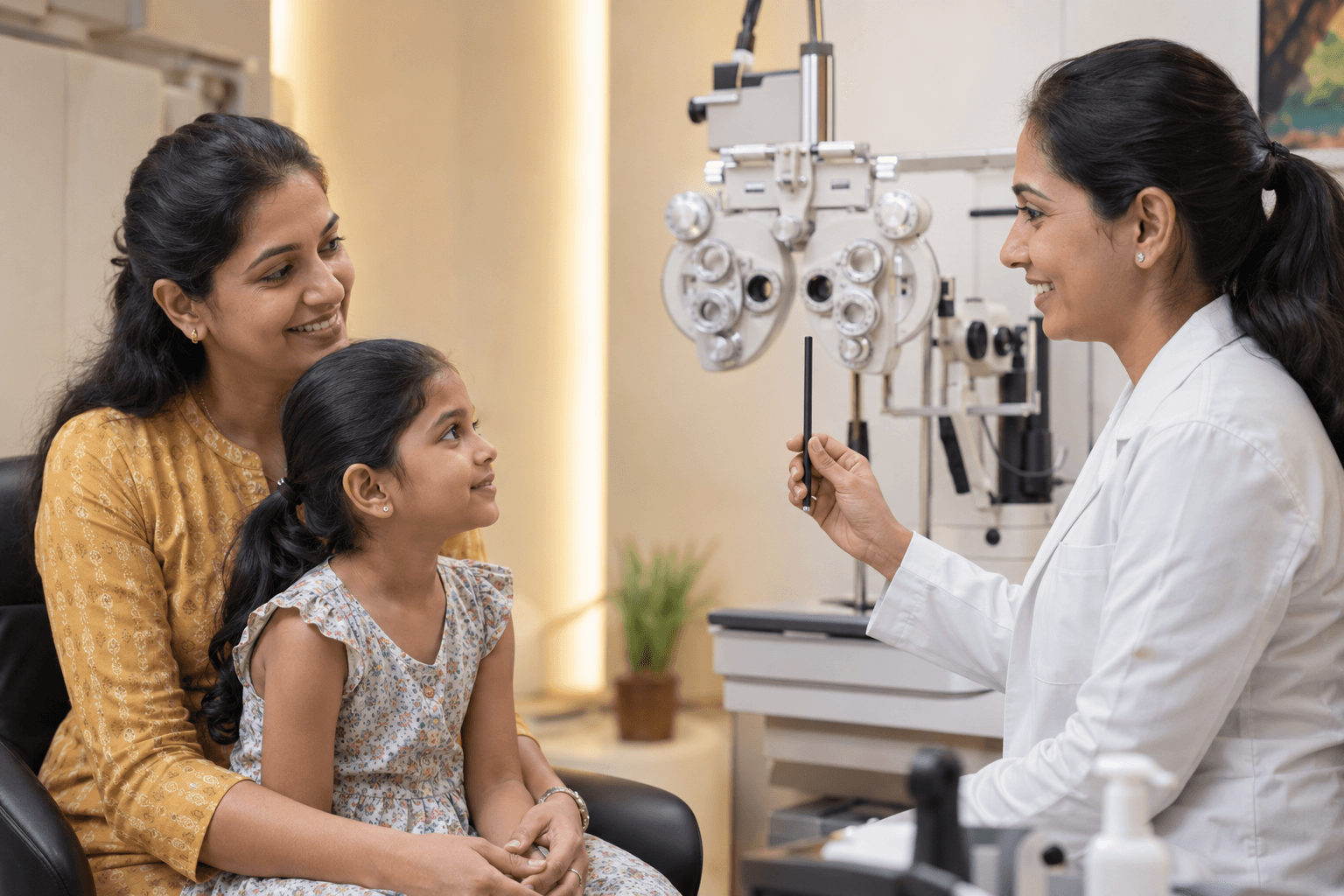
We recommend the first comprehensive eye exam at age 3, and again before starting school. Children do not need to be able to read letters — we use picture charts and other non-verbal tests. After that, annual checks through school years are ideal. Children whose parents wear glasses should be checked earlier, as refractive errors run in families.
Increasing myopia in school-age children
Short-sightedness (myopia) is growing at a rapid rate among Indian schoolchildren, largely due to reduced outdoor time and increased near work. While glasses correct it, myopia control measures — special lenses, atropine eye drops — can slow its progression, reducing the risk of high myopia complications in adulthood. This is something worth discussing at your child's eye appointment.
“A child who struggles to see the blackboard in class is not inattentive. The earlier we find it, the easier it is to fix — and the greater the difference it makes to their learning.”